

Simcocks Advocates is proud to announce that the firm has, for the seventeenth consecutive year, earned Top Tier status by independent directory the Legal 500 in its 2026 rankings, published earlier this month.
Led by CEO Phil Games, the Private Client department at Simcocks’ is ranked in Tier 1 by the group, placing it among the best on the Island and globally. Other departments highly ranked are Commercial Property, Dispute Resolution, Corporate & Commercial and Banking & Finance. Testimonials include:
“We have worked with the Simcocks team extensively over a number of years now. They are very aware of the client’s structure and requirements and very responsive as well, while taking a commercial approach to get things done.”
“For our company’s legal needs, Simcocks’ corporate and commercial team delivered exceptional results. Their unique strength is industry-specific expertise, providing tailored, proactive advice. We can only recommend their expertise and proactive approach to anyone looking for no nonsense advice that delivers.”
Directors Irini Newby and Phil Games remain in the Legal 500 Hall of Fame UK, a sought-after commendation that indicates “exceptional legal talent”. Director Alex Spencer, advocates Chris Brooks and Kevin O’Loughlin are all ranked as “Leading Partners” and Caroline Jennings as a “Next Generation Partner”. Several other advocates have been named “Recommended Lawyers”, including Elizabeth Simpson:
“Elizabeth Simpson has the deep industry knowledge mentioned above, and is very close to her clients. She is determined to get great results for the clients and will work tirelessly to achieve that.”
And for Winston Taylor:
‘Winston Taylor was totally on top of my case, thinking ahead and extremely thorough. I have a very clear idea of our direction and a realistic expectation of outcome and risk. Always responds in a timely manner to my queries.’
Another testimonial for the Dispute Resolution & Litigation team:
“The Simcocks dispute resolution team under Chris Brooks is top-tier. Their unique strength lies in combining expert legal knowledge with genuine client understanding. They prioritise finding the right resolution, not just any win, and maintain clear, consistent communication at all times throughout lengthy legal processes.”
CEO Phil Games commented on the Legal 500 rankings:
“We are delighted to rank in the Top Tier once again and to have received such wonderful feedback from those clients and associates that Legal 500 approached for testimonials. After over 40 years in the industry, it is clearer than ever to me that people are the key to good business, and I appreciate every talented person I work with and every client we represent.”

Douglas based law practice, Simcocks Advocates, is pleased to announce the appointment of Eleanor Robb to the position of Trainee Advocate.
Born and educated in the Isle of Man, Eleanor obtained her law degree at the University of York, and has returned in order to undertake her Articles and eventually become a Manx Advocate. As part of her training, she will gain experience in various areas of law, and is currently working within the Corporate & Commercial department.
Eleanor ran the Edinburgh Marathon in 2024 and the Manchester Half Marathon in 2023 in aid of Cancer Research UK. She was a member of the university hockey club and its committee during her time at York. In her final year, she was Charity Secretary, which involved organising sporting events for charity.
CEO Phil Games commented on the appointment:
“We’re delighted to have Eleanor join us for her training. As well as being exceedingly clever, she has an enthusiasm, energy and empathy that will stand her in good stead for her future career. I know she will be a great asset to Simcocks.”
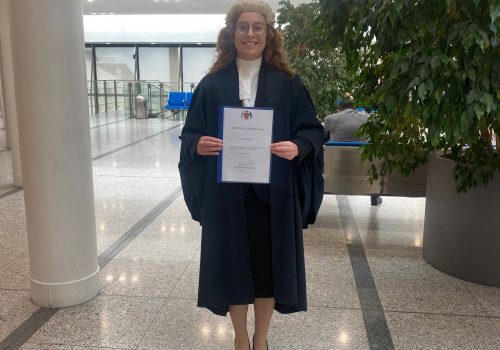
Simcocks is pleased to announce the admission of Emily Morton to the Isle of Man Bar.
Emily joined Simcocks as a Trainee Advocate in September 2022, having obtained her Joint Masters of laws degree between the University of Dundee and CY Cergy Paris Université in France, focusing on International Commercial Law.
Since joining the firm, Emily has experienced working within various areas of law, having spent time in the Litigation, Corporate and Commercial, Property and Private Client departments. Her current role focuses primarily on property law.
Emily said:
“I’m very grateful to everyone at Simcocks who has helped, guided and mentored me over the last three years. I couldn’t have done it without their support and I really look forward to continue working alongside my fantastic colleagues, gaining more experience and putting my knowledge into practice for my clients.”
Phil Games, CEO of Simcocks commented on the commission:
“We are really proud of Emily’s achievements. She has thrown herself into her work, studies, Island life and has become a very valuable member of the Simcocks team, taking part in social and charity events with her trademark enthusiasm and energy. I know she will be a dedicated, diligent and compassionate advocate.”

We are pleased to be sponsoring a Crime Writing event for Manx LitFest 2025, a literary celebration that has become an annual tradition on the Island since 2012.
Crime lovers, budding authors and bookworms are encouraged to book tickets to join local published crime writer Rakie Bennett for the event. Rakie is author of three published thriller novels, one of which is set on our beautiful Isle of Man. She will host the talk in conjunction with international bestselling crime authors, Clare Mackintosh and MJ Arlidge, discussing how to craft the perfect crime, create exciting storylines for characters to embark on, and even let you in on tips about how to get your ideas onto paper.
Phil Games, CEO of Simcocks commented:
“Simcocks takes great pride in supporting a wide range of wonderful Manx charities, whilst simultaneously promoting engagement with the arts on the Island. We believe that nurturing local talent and immersion in literature is highly important. We’d love to see Manx people being inspired and supported throughout their writing journeys, and for Simcocks to have a role in that would be an honour.”
To book a place on the Crime Writing event on Thursday 25 September at Quayle’s Hall in Ramsey visit: https://www.ticketsource.co.uk/manxlitfest/the-art-of-crime-writing-with-clare-mackintosh-and-mj-arlidge/e-vzylyr
Photo: Simcocks’ Emily Morton, left, with Rakie Bennett from Manx Litfest.

The following article by Kevin O’Loughlin was published in the STEP Journal, Issue 4 2025.
The area of crypto-asset law and regulation is a rapidly evolving one. This article outlines recent developments in the Isle of Man.
This article is relevant to persons considering a crypto business in the Isle of Man, and Isle of Man persons (including trustees) considering investing in crypto-assets.
Crypto-asset law
The common law regards crypto-assets as property[1]. Some uncertainty exists whether crypto-assets would be classified as things in action, in the common law’s traditional division of personalty (i.e. property other than land) into things in possession and things in action, or as a form of intangible tertium quid[2].
The Isle of Man High Court has granted an injunction in relation to the contents of a crypto-asset “wallet”[3]. The injunction was lifted at an interlocutory hearing (due to AML/CFT CDD and supervision issues), but no doubt that the wallet was property arose in the case.
Crypto-assets could in principle be held on trust under Isle of Man law, though there would be other considerations for a trustee acquiring crypto-assets.
As yet, legislation similar to the UK Property (Digital Assets etc) Bill has not been introduced. That Bill would, if enacted, provide that a thing, including if digital or electronic in nature, is not prevented from being an object of personal property rights merely because it is neither a thing in possession or a thing in action. A similar Bill may be forthcoming in the Isle of Man in due course, as the legal positions appear comparable
Crypto-asset regulation
The Isle of Man has several regulatory regimes in the financial services area.
These include the Financial Services Act 2008 (which regulates investment services), the Collective Investment Schemes Act 2008 (which regulates CISs) and the Designated Businesses (Registration and Oversight) Act 2015.
The DBROA 2015 is a framework for oversight of AML/CFT compliance. In general terms, crypto-asset activities are regulated only within the DBROA2015.
The Isle of Man Financial Services Authority in 2024 consulted in relation to changing the regulation of crypto-asset activities. It decided to maintain the approach of regulation under the DBROA 2015 only, but to keep the matter under review and monitor developments in international standards and other jurisdictions.
The IoMFSA has since published guidance in relation to crypto-assets and the regulatory perimeter. Essentially this states that the FSA looks to the substance of the activity being undertaken rather than the form.
So if, for example, a crypto-asset represents rights to equity or shares in a company’s profits, the crypto-asset would probably be regarded as a security or a derivative and so within the FSA08. On the other hand, crypto-assets which are endogenous (i.e. rights unto themselves only, such as Bitcoin) would not be a security.
Similarly, a crypto-asset that represents underlying assets could be a unit in a CIS. Crypto-assets which are endogenous would not themselves be units in a CIS, as there is no underlying property, but an arrangement that invests in crypto-assets could be a CIS.
The IoMFSA guidance indicates that, if a crypto-asset is to amount to (and be regulated as) e-money within the FSA08, it must have several characteristics, including holding fiat monetary value and convertibility into fiat.
Crypto-asset tax reporting
In April 2021 the G20 mandated the OECD to develop a framework providing for the automatic exchange of tax-relevant information on crypto-assets. In August 2022, the OECD approved the Crypto-Asset Reporting Framework (CARF), a new tax transparency framework which provides for the automatic exchange of tax information on transactions in crypto-assets in a standardised manner with the jurisdictions of residence of taxpayers[4].
The Isle of Man has committed to implementing the CARF[5]. The government intends to introduce implementing legislation before the end of 2025. It is anticipated that exchanges of information would commence by 2027.
Conclusion
Isle of Man law will have no difficulty with crypto-assets as property (i.e. things in action), including as part of trust assets.
At present, the regulation of crypto-asset activities relates mainly to AML/CFT, however that may change in coming years depending on international standards and developments.
The Isle of Man has a long-standing policy of positive engagement with global standards to combat ML/FT, and can be expected to be an early implementer of CARF.
Ends
Kevin O’Loughlin, ‘CyberMann’, STEP Journal (Issue 4, 2025), https://journal.step.org
[1] E.g. Fetch.ai Ltd v Persons Unknown [2021] EWHC 2254 (Comm) at [9], a case which related to various cryptocurrencies
[2] The Law of Personal Property, Bridge et al, 3rd ed. paragraph 8-049
[3] Caldwell and others v CasinoCoin Foundation and others (judgment of 31 August 2021)
[4] https://www.oecd.org/en/publications/international-standards-for-automatic-exchange-of-information-in-tax-matters_896d79d1-en/full-report/component-3.html#execsumm-d1e119-120427bb17
[5] https://www.gov.im/categories/tax-vat-and-your-money/income-tax-and-national-insurance/international-agreements/crypto-asset-reporting-framework/

An employee of Douglas-based Simcocks Advocates has retired after almost 50 years with the company.
Jayne Hicks started to work for Howard Simcocks in 1976 straight out of school as an Office Junior. She gained a wealth of experience and worked as a Legal Secretary for the majority of her career. She most enjoyed working with Chris Arrowsmith, now Deputy High Bailiff, in the Litigation department for many years.
The Simcocks team are taking Jayne out for cocktails to celebrate this milestone and to see her off in style.
Phil Games, CEO, who worked with Jayne since he joined Simcocks in the 1980s, commented:
“Jayne will be greatly missed for her competence and efficiency, of course, but mostly for her sense of fun and mischief! She joined Simcocks as a teenager and while we’ve seen her grow up and become a mother and then grandmother, she has never lost that youthful outlook. I know she is going to have a great time in her retirement.”
Simcocks is well known for having an impressive level of staff retention over long periods. The fifteen longest serving staff at the law practice clock up a total of 375 years between them; an average of 25 years each.

Simcocks Advocates is proud to announce that it has once again received exceptional rankings from Chambers & Partners in its 2025 High Net Worth guide, which awarded the firm a Band 1 ranking, with two of the Private Client team receiving Recommended Lawyer status.
Simcocks has been ranked in the highest category under Offshore Trusts with a special mention to advocates Phil Games and Kevin O’Loughlin. The independent directory includes the following feedback on the company:
- “The Simcocks team have a huge amount of knowledge and experience. They are always able to break down the most complicated matters into understandable, bite-sized chunks.”
- “Simcocks have excellent technical knowledge and a detail-oriented approach.”
Law firms and individual lawyers are ranked in bands from 1-6, with Band 1 being the best. The qualities on which rankings are assessed include technical legal ability, professional conduct, client service, commercial astuteness, diligence, commitment, and other qualities most valued by the client.
Simcocks has a dedicated Trusts team for both non-contentious and contentious matters, acting for both corporates and private clients. The team work on the creation, administration and restructuring of trusts and foundations, advising a mixture of corporate trustees, high net worth families and individuals. They also liaise with the firm’s litigation department on contentious matters relating to trusts.
CEO Phil Games, who is head of the Private Client team at Simcocks, received a Band 1 ranking, and is well respected for his private client practice. One Chambers source says:
“Phil Games is extremely experienced, commercially astute, personable and solutions-oriented.”
Kevin O’Loughlin has consistently topped the rankings over the years, with feedback highlighting his expertise and meticulous eye of detail. A Chambers source has commented:
“Kevin has excellent technical knowledge.”
“Kevin O’Loughlin is extremely knowledgeable.”
Phil Games commented on the rankings:
“We’re proud to have attained Band 1 status again this year. Independent directories such as Chambers & Partners are so useful for clients to see what areas each law firm and lawyer excels in, and we are grateful to be ranked so highly once again. It’s testament to our team’s expertise and customer focus.”

In September, a team of walkers from Simcocks Advocates, including Directors Phil Games and Irini Newby, will walk from Walton in Cumbria to Brocolitia in Northumberland along Hadrian’s Wall, to raise funds for the Isle of Man Hyperbaric Chamber.

The firm has pledged to help HBOT IOM raise the £750,000 they need in order to commence providing this much-needed service to the Island. In June they held a tombola for the charity, raising £2,395, and now they’re going further afield.
Phil Games, CEO, said, “I wanted us to do a charity project that both raises money for this great cause, and increases well-being and a sense of bonding within our team. Taking part in social, active events is so important to build effective, happy work environments, and if we can do that while helping out a fantastic local charity all the better.”
If you would like to sponsor the hikers you can contact us or simply donate directly to HBOT.


The scope of the Isle of Man common law power to assist foreign insolvency practitioners
Introduction
In 2004, the Isle of Man court in Re Impex[1]decided that the court had a common law power to co-operate with and assist other courts in relation to insolvency matters. The scope of that power has since been examined at the highest judicial levels.
In 2006, during oral submissions in the hearing before the Privy Council in Cambridge Gas[2] (a corporate insolvency case) Counsel argued that “insolvency is different”. In that spirit, the Privy Council departed from established principles of private international law in order to assist the US bankruptcy court.
In 2012, the Supreme Court in Rubin[3] considered that insolvency is insufficiently different to upset established principles of private international law, which it said would be to legislate, and that Cambridge Gas was wrongly decided.
In 2014, the Privy Council in Singularis considered that (as had the Isle of Man court in re Impex) insolvency is sufficiently different for the common law to uniquely confer wide investigatory powers on insolvency practitioners.
Most recently, in 2024, the Supreme Court’s decision in re Bedzhamov[4] indicates that insolvency is not so different after all.
The difference of approach between the Privy Council and the Supreme Court may stem from the impoverished statutory framework for cross border co-operation in corporate insolvencies in certain jurisdictions, including the Isle of Man, in comparison to the United Kingdom where a wide jurisdiction to co-operate is conferred by statute. The Privy Council therefore seeks to find common law powers to take the place of the statutory powers which exist elsewhere. Isle of Man insolvency legislation is being reviewed and updated and new statutory powers to assist foreign courts may be introduced[5].
Pending such statutory intervention, it is submitted that the Isle of Man judiciary must do their best to fill the void, including boldly developing common law powers to assist in cross border insolvencies which in other jurisdictions are conferred by statute.
Background to the common law power to assist
The Isle of Man courts are internationalist in outlook. This is inevitable given the global nature of commercial activity that operates in and through the Island, and the movement of individuals to and from the Island. The Isle of Man courts endeavour to assist the courts of foreign friendly nations, provided the Isle of Man court has jurisdiction to do so. The question of jurisdiction goes to the heart of the limits to assist in relation to foreign corporate insolvency proceedings. In the United Kingdom powers to assist foreign courts in corporate insolvencies have been conferred by statute since 1986. But the Isle of Man does not have equivalent statutory provisions. English decisions are persuasive authority as to Isle of Man law, but the fact that statutory powers to assist exist in England reduces the need to resort to the common law power. This in turn means that there has been little English common law authority to guide the Isle of Man courts, though this is recently changing.
The Isle of Man courts have statutory jurisdiction to assist courts having bankruptcy jurisdiction in certain countries[6], however this only applies to individual (not corporate) insolvencies.
The Isle of Man courts have endorsed the principle that bankruptcy (whether personal or corporate) should be unitary and universal; there should be a unitary bankruptcy proceeding in the court of the bankrupt’s domicile which receives worldwide recognition and it should apply universally to all the bankrupt’s assets[7]. A corollary of this principle is that the court with jurisdiction over the bankruptcy should be assisted by courts in other jurisdictions. The limits to the assistance which the court can give at common law is the subject of several recent cases, which start with Deemster Doyle’s decision in re Impex, and travel though Cambridge Gas, Rubin, Singularis and re Bedzhamov.
Re Impex
In re Impex Services Worldwide Limited [8] the English court had appointed liquidators of an English company suspected of fraud and had issued a letter of request to the Isle of Man court requesting that two Isle of Man companies which had traded with Impex be ordered to produce all documents relating to that business and requiring that a director of the companies submit to oral examination before the Manx court. The Isle of Man court decided, guided by English common law prior to statutory intervention, that it had power at common law to assist by making these orders.
The court decided that at common law the court should recognise the appointment by foreign courts of insolvency officers in corporate insolvencies, that with such recognition comes a wide and discretionary common law jurisdiction to assist other courts in relation to insolvency matters, but that in exercising such discretion the Isle of Man court would in particular have regard to the rules of private international law.
The subsequent decisions of the Privy Council and the Supreme Court, at least after the unorthodoxy of Cambridge Gas was expunged, illustrate the soundness and durability of this decision of the Isle of Man court.
Cambridge Gas
Cambridge Gas concerned an Isle of Man company Navigator Holdings plc (“Navigator”) which had filed for relief under Chapter 11 of the United States Bankruptcy Code in New York, thereby submitting to the jurisdiction of that court. Cambridge Gas Transport Corporation (“CGTC”) was a company incorporated in the Cayman Islands and was the majority shareholder in Navigator but had not submitted to the jurisdiction of the New York court. The New York court confirmed a Chapter 11 plan which essentially involved the assets of Navigator being taken over by the creditors. The mechanism which the plan used to vest the assets in the creditors was to vest the shares in Navigator (which had no economic value) in the creditors’ representatives. The committee of creditors petitioned the Isle of Man High Court for an order vesting the Navigator shares in their representative. CGTC as shareholder opposed this on the grounds that it had never submitted to the jurisdiction of the New York court and therefore on the basis of established private international law rules the order of that court was not enforceable against it in the Isle of Man.
The Privy Council (sitting as the Isle of Man final court of appeal) decided that if bankruptcy proceedings fell into either category of judgments in rem or in personam, CGTC would have succeeded. However it decided that bankruptcy proceedings fell into neither category but existed to provide a collective mechanism of execution against the debtor’s assets. It considered that the principle of universality underlay the common law principles of judicial assistance in international insolvency, and those principles were sufficient to confer jurisdiction on the Manx court to assist by doing whatever it could have done in the case of a domestic insolvency. Because the Privy Council considered that the Manx court could have given effect to the Chapter 11 plan through a court sanctioned scheme of arrangement, in order to avoid parallel proceedings the court had a common law power to give effect to the plan as if such a scheme had been implemented.
The decision appeared to indicate that insolvency proceedings were indeed different, and that the normal private international law relating to the enforcement of foreign judgments did not apply to such proceedings.
However, six years later, in Rubin, and more recently in re Bedzhamov, the Supreme Court has significantly limited this approach by reference, as foreshadowed by the Isle of Man court in Impex, to the established rules of private international law.
Rubin
Rubin concerned The Consumers Trust (“TCT”) established in the United Kingdom by Eurofinance SA a company incorporated in the British Virgin Islands. Eurofinance SA was the beneficiary in default under TCT and as such received payments from TCT. TCT became insolvent; its receivers caused it to apply to the US Bankruptcy Court for relief under Chapter 11; and the receivers then obtained default judgment in the US Bankruptcy Court against Eurofinance SA for “clawback” of about US$10m based on the avoidance of certain amounts paid by TCT to Eurofinance SA.
The receivers sought to enforce the default judgment at common law in England. Eurofinance SA opposed enforcement on the principle of private international law that a foreign judgment in personam is only enforceable in England if the judgment debtor was present in the foreign country when the proceedings were commenced or if the judgment debtor submitted or had agreed to submit to the jurisdiction (the “Dicey Rule”).
The Court of Appeal decided on the basis of the decision of the Privy Council in Cambridge Gas that the Dicey Rule did not apply to foreign judgments in bankruptcy avoidance proceedings and that the judgment was enforceable in England. The Supreme Court disagreed.
Lord Collins giving the majority judgment in the Supreme Court considered Cambridge Gas at length. He said the question was whether as a matter of policy, the court should, in the interests of universality of insolvency proceedings, devise a rule for the recognition and enforcement of judgments in foreign insolvency proceedings which is more expansive, and more favourable to liquidators and other office-holders, than the traditional common law rule embodied in the Diceyrule, or should it be left to legislation.
Lord Collins noted that prior to Cambridge Gas there had been no suggestion that there might be a different rule for judgments in personam in insolvency proceedings and other proceedings. He considered that to develop the law in this way would not be an incremental development of existing principles but a radical departure from substantially settled law which had all the hallmarks of legislation; and that this should be a matter for the legislature and not for judicial innovation. It followed he said that Cambridge Gas had been wrongly decided.
The Supreme Court had gone some way to restoring orthodoxy and the established rules of private international law. The Privy Council was to go further in Singularis.
Singularis
The Privy Council reconsidered Cambridge Gas in Singularis[9], a case similar to re Impex. In Singularis, a liquidator was appointed by the Cayman Islands court to wind up Singularis Holdings Limited, a company incorporated in the Cayman Islands. The liquidator applied to court in Bermuda to order PwC, as former auditors of the company, to provide information and documents. The Privy Council (sitting as the Bermuda final court of appeal) unanimously considered that:
- Cambridge Gas is correct in so far as it constitutes authority for the principle of modified universalism, namely that a domestic court has a common law power to assist foreign winding up proceedings so far as it properly can.
- Cambridge Gas is incorrect as authority for the proposition that this includes a common law power to do (subject to its own law and public policy) whatever the domestic court could by statute have done in a domestic insolvency “as if” that statutory provision applied to international insolvency.
- Cambridge Gas is incorrect as authority for the proposition that the common law power referred to in (a) above is itself the source of the court’s jurisdiction over those affected and that the absence of jurisdiction in rem or in personam according to ordinary common law principles is irrelevant. Rather, the domestic court must act within the limits of the statutory and common law powers which it otherwise has, including any proper development of the common law.
A majority of the Privy Council considered that (as the Isle of Man court had decided in re Impex) there is a power at common law to assist a foreign court of insolvency jurisdiction by ordering the production of information in oral or documentary form which is necessary for the administration of a foreign winding up. The Privy Council considered that this power is subject to several limitations.
Two of those limitations are that the power is available only to assist the officers of a foreign court of insolvency jurisdiction and would not be available to assist a voluntary winding up; and that the power does not enable foreign officeholders to do something which they could not do even under the law by which they were appointed. On the basis of the latter limitation, the Privy Council decided that the Bermuda court should exercise its discretion by declining to make the order sought by the liquidator.
Re Bedzhamov
Inre Bedzhamov[10] a Russian court declared Mr Bedzhamov bankrupt and appointed a trustee in bankruptcy to realise his assets. The trustee applied to the English court for assistance under the common law power (as no statutory powers applied), including recognition of the Russian bankruptcy and of her appointment as the trustee and for an order vesting a London house in her possession and control as his trustee.
The Supreme Court decided that the assistance which the English courts could give at common law was limited by the rules of the substantive law of England, including the immovables rule.
The immovables rule is an established principle of private international law to the effect that questions as regards rights to and interests in land and other immovable property are governed by the law of the country in which the property is situated (the lex situs) and that jurisdiction to decide those questions belongs to the courts of that country. Where immovable property is situated in country A, neither the law nor the courts of country A will recognise or give effect to any laws or judicial decisions of other countries which purport to govern or decide issues of rights to and interests in that immovable property, save to the extent of any exceptions under the law of country A.
The trustee submitted that the English court may at common law recognise and give effect to the rule of Russian bankruptcy law that all the property of the bankrupt, including interests in land located in England, forms part of the bankrupt estate.
The Supreme Court however decided that to do so would be fundamentally at odds with the immovables rule, the effect of which is that at common law no recognition will be given to any provision of foreign law or any order of a foreign court which purports to affect rights to or interests in land located in England. Hence the common law did not recognise the house in London as being within the scope of Mr Bedzhamov’s bankruptcy.
Once again, the Supreme Court had limited the common law power of assistance in the same way as the Isle of Man court in Impex, by reference to the established rules of private international law.
Binding effect of these decisions in the Isle of Man
Decisions of the Supreme Court in England are not binding but are highly persuasive in the Isle of Man courts, and should generally be followed if there is no Isle of Man legislation or clear case law to the contrary, unless exceptionally local conditions justify divergence[11]. Decisions of the Privy Council sitting other than as an Isle of Man appellate court, although again not binding on Isle of Man courts, are of even more persuasive authority than decisions of the Supreme Court[12]. Decisions of the Privy Council sitting as the final Isle of Man appellate court are binding on Isle of Man courts.
Although Cambridge Gas was a decision of the Privy Council as the final Isle of Man court of appeal, and so binding on Isle of Man courts, the decision can be distinguished from later cases and can be narrowly expressed. For example, Lord Mance in Rubin[13] considered that the purpose of the order made by the Isle of Man court in Cambridge Gas was simply a mechanism of collective execution against the property of the debtor (Navigator). He considered that, as the shares owned by Cambridge Gas had no value (the company being insolvent), and as in insolvency shareholders’ interests yield to those of creditors, the vesting of the shares in Navigator’s creditors was no more than a mechanism for a distribution of Navigator’s assets among its creditors, which did not affect or concern Cambridge Gas. Rather than agreeing with the majority that Cambridge Gas had been wrongly decided, Lord Mance reserved his position[14].
The decisions in Rubin, Singularis and re Bedzhamov are not strictly binding on the Isle of Man courts, but it is unlikely that the Privy Council sitting as the Isle of Man final court of appeal would depart from these decisions. Hence, the lower Isle of Man courts are likely to follow those decisions. That said, the precise scope of the Singularis and re Bedzhamov decisions is narrow.
Strictly, the decision in Singularis was that if there is a common law power to assist as outlined above, then it is subject to the limitation that the power does not enable foreign officeholders to do something which they could not do even under the law by which they were appointed. So expressed, the decision is quite narrow, and this limitation seems uncontroversial. It is therefore quite certain that the Isle of Man courts will follow the decision at least in this respect, though it is submitted that it would be open to them not to follow the decision in other respects.
The practical effect of the decision in re Bedzhamov is that the immovables rule will mean that Isle of Man land is not within a foreign bankruptcy estate as a matter of Isle of Man law.
Discussion
It is clear that the Isle of Man courts have a common law power to recognise the appointment of insolvency officers in foreign corporate insolvencies, and to assist in relation to insolvency matters, but the scope of the power is still being developed.
Based on the decisions after Cambridge Gas, the power is subject to the limitations of private international law, as was recognized by the Isle of Man court in Impex.
First, there is no jurisdiction to do whatever the court could have done in a domestic insolvency, “as if” the foreign insolvency was a domestic insolvency. In Cambridge Gas the Privy Council held that the court could give effect to the Chapter 11 plan “as if” a scheme of arrangement had been entered into. In the light of subsequent decisions that, as a statement of principle, appears to be a step too far. It seems likely that the Isle of Man courts, although bound by the decision in Cambridge Gas, will narrow its application.
Second, it is clear from Singularis that the power does not enable the Isle of Man court to assist foreign officeholders to do something which they could not do even under the law by which they were appointed. This seems uncontroversial; the common law power to assist should be in support of powers conferred on foreign officeholders by the law by which they were appointed rather than conferring new freestanding powers.
Third, the Privy Council in Singularis considered that the power is available only to assist the officers of a foreign court of insolvency jurisdiction and would not be available to assist a voluntary winding up. The reason given by Lord Sumption for this limitation was that a voluntary winding up is essentially a private arrangement and, although subject to the directions of the court, is not conducted by or on behalf of an officer of the court.
However in cases of insolvency there is a public interest in facilitating investigation of wrongdoing and collection of assets, whether the insolvency practitioner is appointed by a court or voluntarily. In most jurisdictions an insolvency practitioner in an insolvent voluntary winding up will be able to invoke the assistance of his local courts in relation to the winding up, including seeking assistance from foreign courts. On this basis, it is submitted that the Isle of Man common law power to assist should also extend to cases involving an insolvent voluntary winding up where the foreign court has requested such assistance.
Fourth, the common law power itself does not confer additional jurisdiction on the Isle of Man court, which must act within the limits of the statutory and common law powers which it otherwise has, including any proper development of the common law.
Fifth, it is clear from re Bedzhamov that the court’s common law powers of assistance do not permit it to provide assistance which is inconsistent with rules of substantive law, including the rules of private international law.
Development of the common law power
The Isle of Man court in re Impex and the Privy Council in Singularis recognised scope for properly developing the common law power. It is submitted that, in doing so, the Isle of Man courts should be “bold spirits” rather than “timorous souls”[15]. Pending legislation, which in the Isle of Man is clearly needed, it is submitted that the judiciary are justified in seeking where they properly can to fill the gap.
That the common law may develop to meet the needs of the local and international community has been recognised in many decisions of the Isle of Man courts[16]. To do so is not to usurp the legislature, even if the effect of developing the common law may be to replicate statutory law elsewhere.
By way of example, Re Barr[17] concerned the Isle of Man law of contempt. In England, though not in the Isle of Man, the common law in relation to contempt had been changed by statute in a number of respects. The Staff of Government said that it should not be assumed that the Isle of Man court would follow English common law decisions which had been abandoned by Parliament.
It may be that development of the common law power will become unnecessary, with the introduction of modern insolvency legislation, however that will depend on the scope of any new statutory powers to assist in foreign insolvency matters.
Conclusion
Insolvency is different in many ways. Creditors know the risks associated with limited liability conferred on companies by statute, but deserve protection from abuses of that privilege. Such protection necessitates investigation into the affairs of the insolvent company and remedies against wrongdoers, which today will inevitably have cross border implications. The scope of any new legislative powers remains to be seen, but pending that the Isle of Man courts are justified in boldly developing the common law in this area in a manner deserved by a sophisticated and internationally connected jurisdiction such as the Isle of Man.
Kevin O’Loughlin
Advocate
June 2025
This article is an updated version of Kevin O’Loughlin’s essay that won the 2015 George Johnson Law Prize.
[1] 2003-05 MLR 115.
[2] 2005-06 MLR 297.
[3] Rubin v Eurofinance SA [2013] 1 AC 236
[4] Kireeva v Bedzhamov [2024] UKSC 39
[5] Modernised insolvency legislation is expected to be introduced in Tynwald (the Isle of Man parliament) before the end of 2025.
[6] Bankruptcy Act 1988. The countries are the United Kingdom, Austria, Belgium, Denmark, Finland, France, Germany, Greece, Iceland, Italy, Leichtenstein, Luxembourg, Malaysia, Netherlands, Norway, Portugal, South Africa, Spain and Sweden.
[7] For example, Interdevelco v Waste2Energy 2012 MLR 521 at paragraph 65.
[8] 2003-05 MLR 115.
[9] Singularis Holdings Limited v PwC [2014] UKPC 36
[10] Kireeva v Bedzhamov [2024] UKSC 39
[11] Frankland v R (Privy Council) 1987-89 MLR 65.
[12] Frankland v R (SoG) 1978-80 MLR 275.
[13] Paragraphs 181 to 184.
[14] At paragraph 178.
[15] See Deemster Doyle in Lombard Manx v Spirit of Montpellier (judgment of 11 December 2014) referring to Lord Denning’s famous dissenting judgment in Candler v Crane Christmas & Co [1951] 2 KB 164 at 178.
[16] Re Impex 2003-05 MLR 115; R v Parton 2009 MLR 370; most recently in Lombard Manx v Spirit of Montpellier above.
[17] 1990 – 92 MLR 398

In its eighth year, the Simcocks Partnership with Schools initiative has provoked an unprecedented response from the Island’s students.
Designed to encourage young people with an interest in law, the annual essay competition is open to all sixth form students on the Island. A level or Baccalaureate students were invited to write a 1,000 word essay in response to one of these two questions:
- Does the law relating to public order offences adequately protect the right to freedom of expression and freedom of assembly under the European Convention on Human Rights?
- To what extent does intoxication provide a defence to a criminal charge?
Competition for the top spot was fierce, with more entries than have ever been received.
Following a seminar with a group of students interested in law, advocate Caroline Jennings was pleased to see several entries from Ballakermeen High School, and at a very high level. The winning essay, however, came from Castle Rushen High School student, Breesha Jenkins, who wrote an extremely well-researched and erudite essay on freedom of expression. Breesha came in to meet some of the team who marked the essays, including Chris Brooks (left) and Michael Miles, who presented her with the £500 prize. She will also spend a week of the summer holidays at the Simcocks office, gaining some valuable work experience.
Chris Brooks, Head of Litigation, commented:
“We have all been so impressed by the response to this year’s competition. Meeting students at the schools and discussing the issues was a real delight, but reading all the intelligent essays that were sent in was really heartening. The Island has so many clever, insightful and enthusiastic young people. Congratulations to all those who entered, and to Breesha for her excellent essay.”